The UFC Octagon Explained: Size, Fence, Canvas and the Smaller Cage
How big is the UFC Octagon?
The standard UFC Octagon has a fighting area 30 feet (9.1m) across, inside an eight-sided structure 38 feet (11.5m) in diameter. Those are the figures the UFC publishes on its official Octagon page, and they apply to the cage used at arena events from the numbered pay-per-views to most Fight Nights.
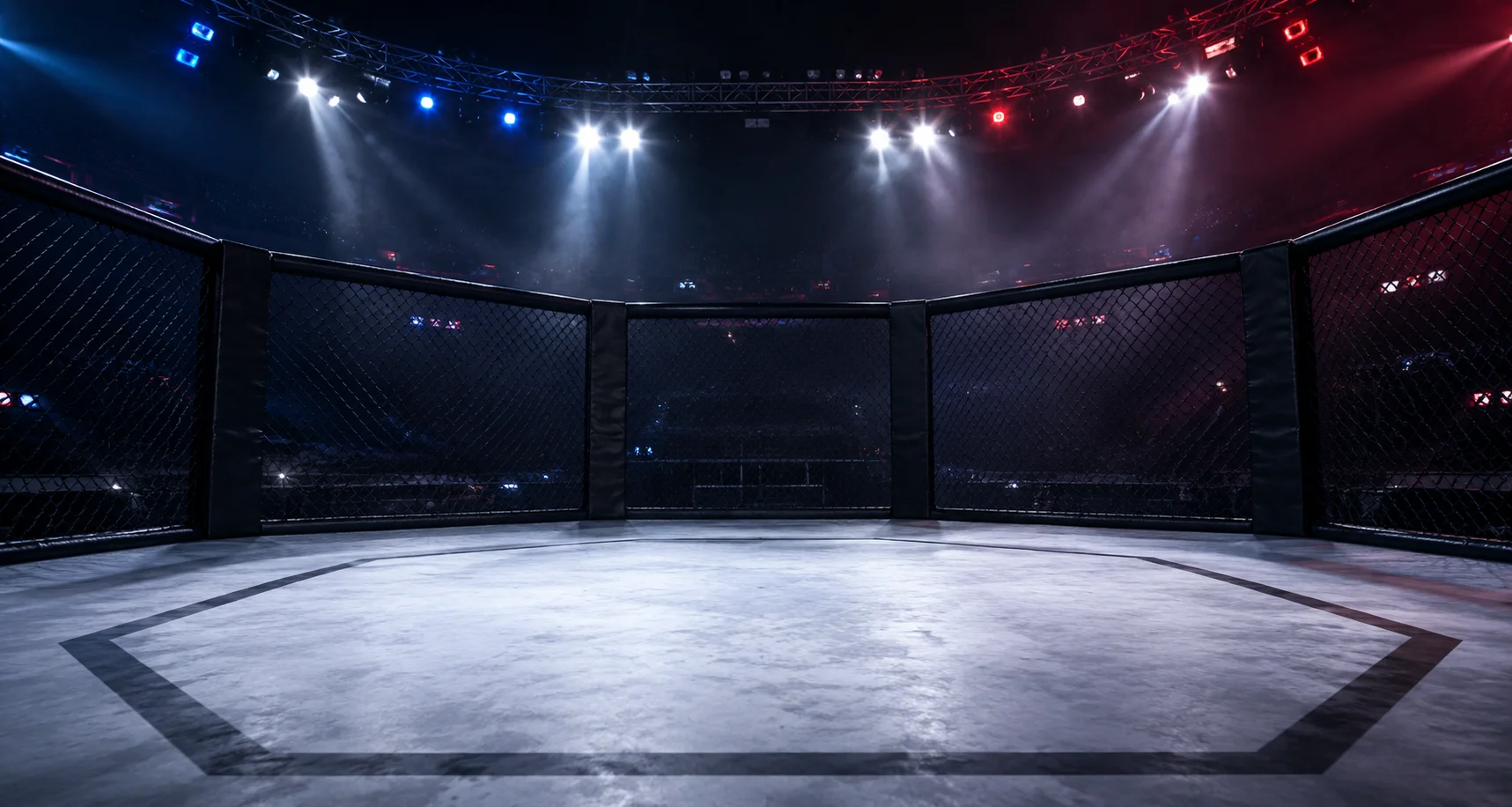
The rest of the official spec matters more to fighters than fans realise. The canvas sits 4 feet (1.2m) off the ground on a raised platform. The fence runs 5 feet 9 inches (1.8m) from canvas to top rail. A 4-foot walkway rings the outside, and there are two entrance gates on opposite sides, each 3 feet wide and 5 feet high, so anyone taller than five feet has to stoop on the way in.
There is also a second, smaller Octagon with a 25-foot (7.6m) fighting area. The UFC uses it at the Apex in Las Vegas and in smaller venues, and it fights very differently. More on that below.
How much floor space do fighters actually get?
Roughly 746 square feet in the big cage and 518 square feet in the small one. The UFC does not publish floor area, so these figures assume the quoted width is measured from one flat side to the opposite flat side, which gives each of the eight sides a length of about 12.4 feet in the 30-foot cage and about 10.4 feet in the 25-foot cage.
Whichever way you measure, area scales with the square of the width, so the ratio is fixed: the 25-foot cage has about 30 per cent less canvas than the 30-foot cage. Put the other way round, the standard Octagon gives fighters about 44 per cent more room, which is the figure ESPN's analysts quoted when the smaller cage became a talking point in 2020.
For comparison, a UFC fighter in the standard cage has more space than a boxer in the largest ring most commissions allow. Virginia's combat sports rules, for example, cap a square ring at 20 feet inside the ropes, about 400 square feet, while allowing an octagon of up to 32 feet side to side.
What the fence, canvas and posts are made of
The fence is plastic-coated chain link, and the canvas is replaced for every event. The UFC describes its canvas as textured and hand-painted, used once and then retired, which is why each card has its own sponsor and event branding on the mat.
Underneath, the cage has to meet athletic commission rules, and those are surprisingly specific. Kansas, which follows the standard commission template, requires at least one inch of closed-cell foam under a canvas or duck cover that is stretched tight and laced to the platform, chain-link fencing coated in vinyl or a similar material, at least one inch of foam padding on the top and bottom rails, and padding on every fence post and metal part. The platform cannot sit more than four feet above the floor, which is exactly where the UFC builds it.
The same rules set the size range. Kansas allows an enclosure from 20 by 20 feet up to 32 by 32 feet, either circular or with equal sides. That is why you see cages of different shapes in other promotions: the PFL fights in a 10-sided SmartCage, while ONE Championship calls its enclosure the Circle. The eight-sided outline itself belongs to the UFC: the UFC states that the octagonal mat and fenced design are registered trademarks or trade dress of Zuffa, LLC.
The fence is part of the rules as well as the furniture. Holding or grabbing it is a foul under the Unified Rules, and a referee can take a point for it. Our guide to the Unified Rules of MMA covers the fouls in full.
Why the UFC fights in an Octagon instead of a ring
Because the founders wanted an enclosure that did not favour one style and kept grapplers from rolling out. Art Davie and Rorion Gracie, who created the UFC, did not want a boxing ring for the first event in Denver on 12 November 1993; Gracie preferred almost anything to a ring, because grappling does not work well between ropes. The UFC still makes the point today: its fence stops athletes tumbling out, something that happens in a traditional ring.
Who actually came up with the eight-sided shape is still argued over. ESPN's history of the cage, Changing the shape of fighting, records several rival claims. Production designer Greg Harrison says he conceived it alone; SEG producer Michael Pillot says he asked for an octagon in a meeting; fabricator Jason Cusson says he suggested it during a brainstorm. Ideas that did not make it included director John Milius's moat with alligators and an electrified fence, and Davie's netting dropped from the rafters, rejected because it was too flexible to hold a fighter.
Cusson built the first cage in under two weeks in a Los Angeles warehouse from two-by-four timber, three-quarter-inch plywood, vinyl chain-link fencing and two inches of carpet padding, which strikers found hard to plant their feet on. The planned surface shrank from 40 feet in diameter to 30 during design, the railing was later raised to six feet, and SEG was granted a trademark on an octagon-shaped fighting surface in September 1997, which Zuffa inherited when it bought the company. For the rest of that story, read our history of the UFC.
The 25-foot Octagon: where the UFC uses the small cage
The smaller cage is the house cage at the UFC Apex, the UFC's own venue in Enterprise, Nevada, opposite the UFC Performance Institute. The Apex opened on 18 June 2019, seats around 1,000 and became famous in 2020 when, after three Jacksonville cards, every US-based UFC event moved there behind closed doors.
It is still busy. The Apex hosts selected Fight Nights and Dana White's Contender Series, and in January 2026 the UFC signed a five-year naming rights deal that renamed it the Meta Apex. It was refurbished with extra seating ahead of the Fight Night headlined by Mateusz Gamrot and Quillan Salkilld on 8 August 2026. If you want to know which cards are Apex Fight Nights and which are arena shows, our UFC event calendar guide explains the difference.
Special venues get their own builds. The 14 June 2026 card on the South Lawn of the White House, headlined by Alex Pereira against Ciryl Gane for the interim heavyweight title, with Ilia Topuria against Justin Gaethje also on the card, used a temporary Octagon put up on the lawn in late May with a temporary arena of around 5,000 seats around it.
Does the smaller cage produce more finishes?
The numbers say yes, but nobody has proved the cage is the cause. The best data comes from the UFC Performance Institute's large study of UFC bouts, reported by ESPN in May 2021. Looking at fights from 2017 to 2019, it found only 39 per cent of fights in the 25-foot Octagon went to a decision, against 51 per cent in the 30-foot cage, with 5 per cent more knockouts and 8 per cent more submissions in the small cage.
An earlier, much smaller snapshot pointed the same way. ESPN Stats and Information counted 18 finishes in 33 fights (54.5 per cent) across the first three Apex events of 2020, against 15 finishes in 32 fights (46.9 per cent) at the three Jacksonville events held in the full-size cage. ESPN itself warned the gap could be down to the kind of fighters booked rather than the cage, and Dana White said at the time that he did not believe the smaller cage was producing more stoppages.
The logic is easy to follow. With 30 per cent less floor, a fighter who wants to stay at range has fewer steps before the fence is at his back, so pressure fighters and wrestlers find it easier to pin opponents against it. ESPN's panel before Curtis Blaydes against Alexander Volkov in June 2020 was close to unanimous that the small cage favoured Blaydes, the wrestler, over Volkov, the long-range kickboxer. Our guide to MMA fighting styles explains why that matchup was so sensitive to space, and how MMA fights end covers every type of finish.
What to watch for in the cage on fight night
Check the venue first. An Apex card means the 25-foot cage, so expect volume strikers who rely on circling to get cornered sooner and wrestlers to have shorter distances to drive through on takedowns. An arena card means the full 30-foot cage, where a fighter with good footwork can keep a chaser walking for 15 or 25 minutes.
Then watch the fence. Pinning an opponent against it, and wall-walking back up when pinned, are skills the ring never demanded, and the padded rails and vinyl coating the commissions insist on are there because fighters are driven into them all night. In the 25-foot cage, a fighter who backs straight up reaches the fence 2.5 feet sooner than in the full-size Octagon, because the centre is 12.5 feet from each side instead of 15.
Finally, look at the canvas. The UFC paints a new one for every event, so the mat a Fight Night prelim opens on is the same one the main event finishes on, sweat, blood and all. That is one reason the fight-night canvas is a single-use item rather than a fixture of the cage.
Sources
- UFC: The Octagon
- ESPN: Changing the shape of fighting
- ESPN: Why the small Octagon could decide Curtis Blaydes vs. Alexander Volkov
- ESPN: UFC outlines its first official concussion protocol as part of 484-page MMA study
- Wikipedia: UFC Apex
- Cornell LII: Kansas Admin. Regs. 128-5-2, professional and amateur mixed martial arts contests
- Virginia Administrative Code: 18VAC120-40-411.20 ring requirements
- Al Jazeera: UFC fighting cage rises on White House lawn
- Wikipedia: Professional Fighters League
FAQs
How big is the UFC Octagon?
The standard UFC Octagon has a fighting area 30 feet (9.1m) across inside a structure 38 feet (11.5m) in diameter. The canvas sits 4 feet off the ground, the fence is 5 feet 9 inches high and there are two gates on opposite sides. A smaller 25-foot version is used at the UFC Apex in Las Vegas and some smaller venues.
How big is the small cage at the UFC Apex?
The Apex uses a 25-foot (7.6m) Octagon instead of the standard 30-foot cage. Because area scales with the square of the width, it has about 30 per cent less canvas, roughly 518 square feet against about 746 in the full-size cage, which gives fighters fewer steps before they reach the fence.
Why is the UFC cage an octagon?
The UFC's founders wanted an enclosure that kept grapplers from escaping through ropes and did not favour one style. An eight-sided fence achieves that, and its designer also pitched it as safe and good for television. Several people involved in the first event in November 1993 claim credit for the shape, and SEG trademarked the octagon-shaped fighting surface in 1997.
Do more fights end in finishes in the smaller Octagon?
The data suggests so. A UFC Performance Institute study of 2017 to 2019 fights found 39 per cent of bouts in the 25-foot cage went to a decision, against 51 per cent in the 30-foot cage. Fighter types, venues and weight classes differ between the two samples, so the cage has not been proved to be the cause.
How high is the UFC Octagon fence?
The fence measures 5 feet 9 inches (1.8m) from the canvas to the top rail, according to the UFC. It is plastic-coated chain link with padded posts and rails, and commission rules require foam padding on the rails and vinyl or similar coating on the fencing so it is not abrasive to fighters.
Is a new canvas used for every UFC event?
Yes. The UFC says its textured, hand-painted canvas is used only once for each event, which is why the branding on the mat changes from card to card. Underneath it, commission rules require at least one inch of closed-cell foam padding, with the canvas stretched tight and laced to the platform.